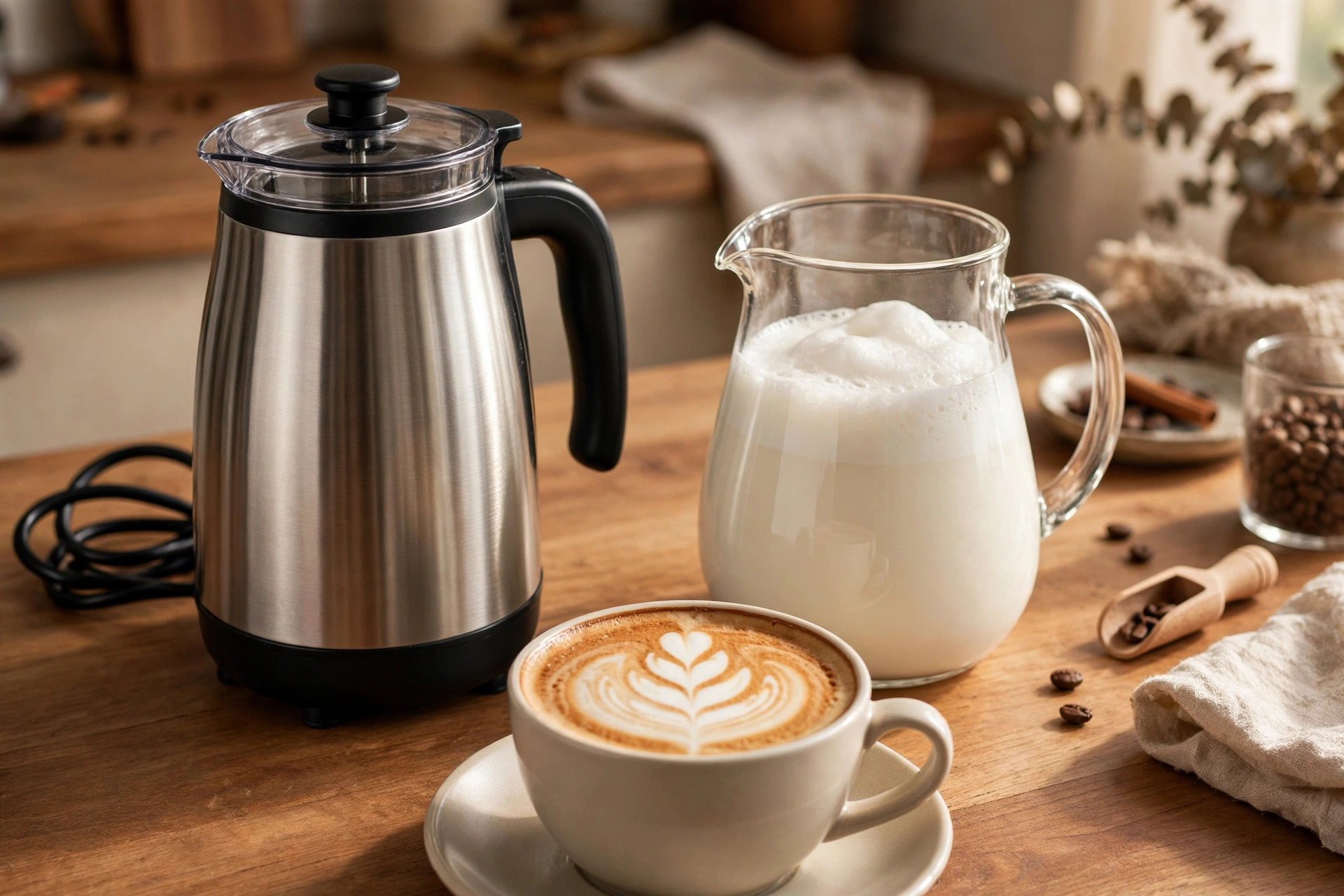
The gap between a home latte and a café latte is almost never the coffee — it is the milk. Café milk is microfoam: thousands of tiny, glossy bubbles folded into silky liquid that pours like wet paint. Home attempts usually land as either hot milk with a dry cap of foam, or a mug of dish-soap bubbles. A good frother closes most of that gap, and the category has matured to the point where real microfoam at home is genuinely achievable. This guide explains the three frother types, what actually creates microfoam, and the five frothers worth buying in 2026.
What microfoam actually is (and why most frothers miss it)
Microfoam is milk heated to roughly 130–150°F with air incorporated as microscopic bubbles — so fine the surface looks like glossy paint, with no visible bubbles at all. Two things have to happen: the milk must get hot enough to sweeten (lactose perception peaks in that range; above 160°F it scalds and tastes flat), and the air must be folded in as tiny bubbles rather than whipped in as big ones.
Most cheap frothers fail the second half. A whisk spinning fast in milk makes big bubbles — foam, technically, but the dry cappuccino kind, not latte microfoam. Real microfoam needs the whisk positioned to create a vortex that folds air down into the milk, plus the technique to stop aerating once the volume grows by about a third. The frother matters, but so does what you do with it — which is why the picks below are ranked on forgiveness as much as on raw capability.
The three frother types, honestly compared
Automatic jug frothers heat and froth at the push of a button: pour in cold milk, press start, get hot frothed milk in a minute or two. Easiest by far, most consistent for beginners, and the best choice if lattes are a daily habit you want frictionless. Downsides: you surrender control — the machine decides the temperature and foam level — and the nonstick-coated jugs need hand washing.
Handheld electric wands are the battery-powered whisk on a stick: you heat the milk separately (microwave or stovetop) and froth it in the cup. Cheapest, smallest, and the most control once you learn the angle — but also the most technique-dependent, and the foam quality ceiling is lower than the other types.
Manual pump frothers (French-press style) use a mesh screen you pump up and down in hot milk. No batteries, no cords, surprisingly good microfoam with practice — the pumping action naturally creates fine bubbles — and nearly indestructible. The most effort of the three, but the most satisfying and the cheapest path to genuinely good foam.
Milk choice matters more than the frother
Whole dairy milk froths best — the fat and protein stabilize the bubbles. Skim makes bigger, drier foam; it works but never gets silky. Among plant milks, barista-edition oat milk is the clear winner — formulated with added protein and fat specifically to foam like dairy. Standard oat, almond, and soy vary wildly; if your plant milk will not foam, it is the milk, not the frother. And always start cold: cold milk gives you more time to incorporate air before it hits temperature.
How we compared them
We compared frother categories on the factors that decide your morning: foam quality (microfoam potential, not just volume), temperature control and consistency, ease of cleaning (the daily tax), speed, noise, durability of the whisk/coating, and how forgiving each type is for beginners. We weighted cleaning and forgiveness heavily — the best frother is the one you actually use every day.
An honest note: these are researched roundups built from manufacturer specifications and aggregated owner reviews — not hands-on foam judging of every model. The picks below are the categories whose owners report the best ratio of good lattes to effort, so you can verify current reviews before you buy.
The five milk frothers worth buying in 2026
Automatic electric frother — the daily-driver pick
Pour, press, pour into coffee: the automatic jug frother is the highest-consistency, lowest-effort path to a home latte. Good ones heat to the right range without scalding, produce genuinely fine foam (not just bubbles), and offer hot/cold and foam-density settings. For the daily latte drinker who values the routine over the ritual, this is the category — it turns a latte into a two-minute habit instead of a project.
The daily tax is cleaning: milk proteins bake onto the jug if you do not rinse immediately, and most jugs are hand-wash only. Buy one with a nonstick interior and rinse it the second you pour — thirty seconds now saves ten minutes of scrubbing later.
- Pros: push-button lattes with consistent temperature and foam; best for daily habits
- Pros: hot and cold modes; density settings for latte vs. cappuccino foam
- Cons: you surrender control — the machine decides the foam, not you
- Cons: hand-wash jugs; rinse immediately or face the scrubbing
4-in-1 stainless automatic frother — the versatile upgrade
A step up within the automatic category: stainless steel construction instead of coated plastic, multiple functions (hot froth, cold froth, hot milk without foam, and sometimes hot chocolate), and larger capacity for making two drinks at once. The stainless jug cleans easier and lasts longer than coated alternatives, and the extra modes mean it earns counter space beyond latte duty.
You are paying for build quality and versatility rather than better foam — the microfoam ceiling is similar to the standard automatic. Buy it if the frother will live on the counter and serve a household, not a single drinker.
- Pros: stainless jug cleans easier and outlasts coated ones; multi-drink capacity
- Pros: four functions cover lattes, cold foam, plain hot milk, and more
- Cons: bigger footprint and higher price for similar foam quality
- Cons: still an automatic — control freaks should look at the manual options
Handheld frothing wand — the cheap-and-cheerful classic
The ten-dollar wonder: a battery-powered whisk that lives in a drawer and froths milk in a mug in thirty seconds. Heat the milk first (microwave is fine), tilt the cup, position the whisk just under the surface to make a vortex, and stop when the volume grows by a third. With practice the foam is genuinely good — not café microfoam, but miles past "hot milk."
The ceiling is technique: beginners make big bubbles, and there is no temperature control — you heat the milk, so you own the scalding risk. But as a first frother, a travel companion, or a backup, nothing beats the value. Get the stainless-steel-shaft version; the plastic ones wobble and die young.
- Pros: cheapest entry by far; tiny, portable, and nearly indestructible (steel shaft)
- Pros: full manual control once you learn the vortex technique
- Cons: you heat the milk separately — no temperature automation
- Cons: technique-dependent; beginners make dish-soap foam at first
Manual pump frother — the microfoam sleeper
The surprise of the category: a French-press-style pump with a fine mesh screen produces some of the best home microfoam available — the pumping action naturally shears bubbles small, and you control everything. No batteries, no cords, no heating element to fail; heat the milk on the stove, pump thirty times, and pour. Baristas respect this tool, which tells you something no marketing copy can.
The cost is effort and learning: thirty pumps is a small workout, and the technique (pump, swirl, tap, pour) takes a few sessions to nail. But it is the cheapest path to genuinely pourable microfoam, and the glass-and-steel ones last effectively forever.
- Pros: best microfoam-per-dollar in the category; no batteries or electronics to fail
- Pros: full control over texture; doubles as a small French press in a pinch
- Cons: manual effort every time — thirty pumps before coffee is a commitment
- Cons: you heat the milk separately; technique takes a few sessions
Compact battery frother — the travel and office pick
A step down in power from the full-size wand, sized for a desk drawer or a suitcase: froth milk for office coffee, hotel-room lattes, or a kitchen with zero counter space. The use case is portability, not performance — it makes perfectly acceptable foam for one mug, and it goes where the automatic jug cannot.
Do not buy this as your only frother if you make lattes daily at home; buy it as the second frother that keeps the habit alive everywhere else. Check battery type in reviews — USB-rechargeable beats coin-cell gobblers.
- Pros: truly portable — office, travel, and tiny kitchens
- Pros: cheapest way to keep the latte habit alive away from home
- Cons: less power than full-size wands; single-mug capacity
- Cons: battery logistics — prefer USB-rechargeable over disposable cells
Our verdict
Daily latte drinkers should buy the automatic jug frother — it makes the habit frictionless, and frictionless habits survive. Households and counter-space committers get the 4-in-1 stainless version. Technique-minded brewers who want the best foam for the least money should get the manual pump frother and spend a week learning it — the microfoam will surprise you. The handheld wand is the perfect first frother and travel backup, and the compact battery version keeps the ritual alive at the office.
The technique that matters more than the tool
Three rules, whichever frother you buy. Start cold: cold milk gives you the longest window to incorporate air before temperature climbs — warm milk foams fast and badly. Stop aerating early: add air only until the volume grows by about a third, then keep the milk moving without adding more — this is the difference between microfoam and meringue. Swirl and tap: after frothing, swirl the pitcher to fold the foam in and tap it once on the counter to pop the big bubbles; the surface should look like glossy wet paint.
Temperature is the silent killer: 130–150°F is the target, and a $10 instant-read thermometer removes the guesswork until your hand learns it. Above 160°F the milk scalds — proteins denature, sweetness dies, and no frother can save it. And pour promptly: microfoam is a temporary emulsion, not a stable state. The beautiful pour happens in the minute after frothing, which is why café baristas move fast — and now you know why. See our milk frother technique guide for the full walkthrough.
Frequently asked questions
Can a home frother make real latte art–quality microfoam?
Yes — with the right technique. Automatic frothers get you close with zero skill; the manual pump gets you all the way there with practice. The milk matters as much as the tool: whole dairy or barista-edition oat, always started cold.
Why is my frothed milk full of big bubbles?
Too much air, added too fast — the whisk stayed near the surface too long. Keep aeration brief (volume up by a third, then stop), swirl to fold, and tap the pitcher to pop the stragglers.
Do I need a steam wand on an espresso machine instead?
A steam wand gives the most control and the best microfoam, but it comes attached to an espresso machine — a much bigger purchase. These standalone frothers are for everyone brewing with a drip machine, French press, or pour-over setup.
How do I clean a frother jug properly?
Rinse immediately after pouring — every time, no exceptions. Milk protein sets fast and becomes concrete. For the weekly deep clean, fill with warm water and a drop of dish soap, run a cycle, rinse thoroughly. Never submerge the electric base.