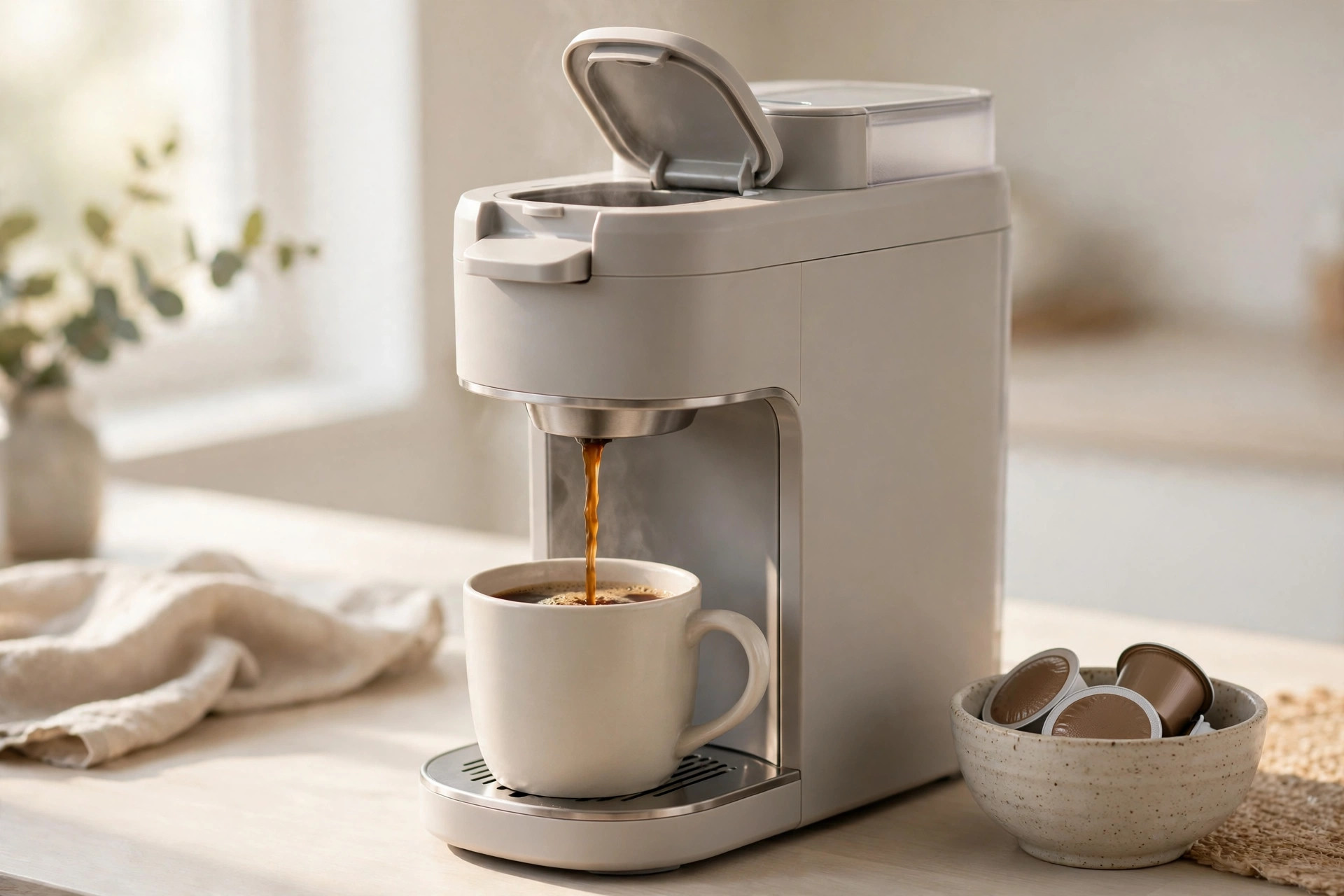
Single-serve is the fastest way to a decent cup and the easiest way to overspend on coffee without noticing. The machine is the cheap part — the pods are the subscription. A $150 machine that drinks 60-cent pods costs more in a year than a $400 espresso machine for a two-cup-a-day household. So this guide ranks machines on the system first and the hardware second: which pods it takes, what a cup actually costs, and whether the coffee in the cup is worth that price.
Brew Dialed is reader-supported. When you buy through links on our site, we may earn an affiliate commission.
Last updated: November 9, 2026. Prices and availability checked November 2026.
Quick picks
In a hurry? These are this guide’s picks, in order — the full reasoning is in the sections below. Prices move fast, so check the current price before you decide.
| Machine | Our take | Typical price |
|---|---|---|
| Keurig K-Supreme | Best for most people | ~$130–$170 → |
| Nespresso Vertuo Plus | Best Nespresso, best crema | ~$150–$180 → |
| Ninja DualBrew Pro | Best dual-brew (pods + grounds) | ~$200–$230 → |
| Nespresso Essenza Mini | Best compact | ~$120–$170 → |
| Hamilton Beach FlexBrew | Best budget | ~$70–$90 → |
The pod-system decision (read before buying anything)
Here is the rule that decides every purchase in this category: you are buying a pod system, not a machine. The machine is a one-time $70–$230; the pods are every morning for years. Three systems dominate, and they do not mix. K-Cups (Keurig) are the widest choice — hundreds of brands, grocery-store availability, roughly 40–70 cents a cup. Nespresso Vertuo pods are Nespresso-only, about 85 cents to $1.20 a cup, but deliver real espresso-style crema and a 5.4-ounce coffee size no K-Cup matches. Nespresso Original pods (Essenza Mini) are the cheapest Nespresso route, with third-party compatible capsules bringing cups down toward 40 cents, and they make true 1.35-ounce espresso shots. Grounds-compatible machines (Ninja DualBrew, FlexBrew) let you skip pods entirely and brew your own beans at drip-coffee prices — the cheapest cup in this guide by a wide margin.
Two practical corollaries. First, count your cups before you count your dollars: one cup a day makes pod cost a rounding error; three cups a day in a two-person household makes the pod bill bigger than the machine within six months. Second, if two people in the house drink different things — one wants decaf, one wants dark roast, one wants a latte — single-serve is genuinely the right answer, and a dual-brew machine is the right answer inside that answer. See our drip coffee maker guide if the household mostly drinks the same pot together; a pot is still cheaper per cup than any pod.
Why single-serve wins (and where it loses)
Single-serve wins on three things: speed (a cup in about a minute, no warm-up ritual), variety (every cup can be a different roast, decaf, or flavor), and zero waste (no half pot poured down the sink at 10 a.m.). It loses on three things too: cost per cup, cup quality ceiling, and waste — the pods themselves. A well-made pour-over or French press beats every pod machine on flavor for a fraction of the per-cup cost, but demands five minutes and a grinder. The honest framing is that single-serve trades coffee quality and cost for convenience, and for busy weekday mornings that trade is often correct. This guide’s job is to make sure you make the trade with your eyes open, on the system whose ongoing cost you actually accept.
The five picks
1. Keurig K-Supreme — best for most people
The default single-serve machine for a reason: MultiStream technology saturates the grounds more evenly than older Keurigs, the Strong button actually changes the cup, and the 66-ounce reservoir means refills are weekly, not daily. Four cup sizes (6, 8, 10, 12 ounces) cover everything from a short strong cup to a travel mug. And the K-Cup ecosystem is the deepest on the market — if a roaster sells pods, they sell K-Cups. Best for: the household that wants one machine, any coffee, no learning curve. Watch out: it is still a K-Cup machine, so the cup tops out at decent, not great — and the per-cup cost is the highest in this guide for daily drinkers. Use a reusable My K-Cup filter with your own grounds to cut the cost when you want to.
2. Nespresso Vertuo Plus — best Nespresso, best crema
The best-tasting cup in this roundup that still counts as single-serve: Centrifusion spins the capsule and produces a thick, real crema that no K-Cup can imitate, and the five cup sizes run from a 1.35-ounce espresso to a 14-ounce alto. The motorized head opens and closes at a touch, and the 60-ounce tank is generous. It is the machine for the drinker who wants an espresso-style cup without learning espresso. Best for: the coffee lover who cares about the cup and is happy inside Nespresso’s walled garden. Watch out: Vertuo pods are Nespresso-only — no third-party capsules, no grocery-store run, roughly a dollar a cup. If that per-cup price bothers you, the Essenza Mini below (Original line) is the cheaper Nespresso path.
3. Ninja DualBrew Pro — best dual-brew (pods + grounds)
The escape hatch from pod lock-in: the DualBrew Pro brews K-Cups on one side and a full 12-cup carafe of grounds on the other, plus a fold-away frother for lattes. It is the only machine here that can be both the weekday pod machine and the weekend pot machine, and the grounds side means your cheapest cup is a scoop of your own beans, not a 60-cent pod. Four brew styles (Classic, Rich, Over Ice, Specialty) cover iced coffee and milk drinks too. Best for: mixed households — one pod drinker, one pot drinker — or anyone who wants pods as an option, not a sentence. Watch out: it is the biggest and priciest machine here, and the carafe side is a good drip brewer, not a great one — see our drip guide if the pot is the priority.
4. Nespresso Essenza Mini — best compact
The smallest serious coffee machine you can buy: barely wider than a mug, it makes genuine 19-bar espresso in two sizes (espresso and lungo) and disappears on a crowded counter or a dorm desk. The Original-line pods are the cheapest Nespresso cups — third-party capsules are widely available — and the machine itself is the least expensive way into real espresso at home. Pair it with a milk frother and you have a latte setup smaller than a toaster. Best for: small kitchens, single drinkers, and anyone whose priority is espresso, not a big mug of coffee. Watch out: it makes espresso-sized drinks only — a 1.35-ounce shot is not a morning mug, and the 20-ounce tank needs frequent refills in a multi-cup household.
5. Hamilton Beach FlexBrew — best budget
The cheapest honest single-serve machine: the FlexBrew brews a K-Cup or a scoop of your own grounds in the included reusable filter, so it never forces you into pod prices. It is simple — one cup size at a time, a modest water reservoir, no app, no touchscreen — and it works. For a guest room, an office desk, a dorm, or a first apartment, it delivers the single-serve experience at a third of the K-Supreme’s price. Best for: tight budgets, second locations, and buyers who want to try single-serve without committing to it. Watch out: the build is plastic and light, the cup quality trails the Keurig, and the small reservoir means refilling every cup or two — fine as a second machine, annoying as the only one.
The traps at this tier
The most expensive trap is ignoring the pod math — a dollar a cup, two cups a day, is $730 a year, which dwarfs any machine price in this guide. Do the multiplication before you fall in love with a machine. The second trap is buying a Vertuo machine and then discovering you wanted third-party pods: Vertuo capsules are Nespresso-only, full stop. The third trap is skipping descaling — hard water clogs single-serve machines faster than any other brewer, and a $15 descaling solution every few months is the difference between a machine that lasts five years and one that dies in eighteen months. The fourth trap is the wrong size: a 40-ounce tank in a three-cup household means refilling before every brew, which quietly kills the convenience you paid for. And the fifth is buying single-serve when the household drinks one pot together — if everyone drinks the same coffee, a drip machine makes better coffee for a tenth of the per-cup cost.
What this guide does not cover
This covers pod and dual-brew single-serve machines for home use — not espresso machines (see our espresso guides), not super-automatics, and not commercial or office multi-cup brewers. It does not cover pod subscription pricing beyond typical per-cup ranges, or water-filtration chemistry beyond basic descaling. If you are choosing equipment for an office of ten or more, talk to a commercial coffee supplier.
Frequently asked questions
Keurig or Nespresso — which should I buy?
Buy Keurig if you want the widest choice of coffee at the lowest pod price and you mostly drink a full mug. Buy Nespresso Vertuo if you want the best-tasting cup and espresso-style crema, and you accept Nespresso-only pods at roughly a dollar a cup. Buy Nespresso Original (Essenza Mini) if you want real espresso shots and the cheapest Nespresso cups via third-party capsules.
Can I use my own coffee instead of pods?
Yes, on three of these five: the Ninja DualBrew Pro and Hamilton Beach FlexBrew brew grounds directly, and the Keurig K-Supreme works with a reusable My K-Cup filter. The Nespresso machines are pod-only by design — that is the trade for their cup quality.
How much do pods really cost per cup?
Typical ranges in November 2026: K-Cups roughly 40–70 cents, Nespresso Original capsules roughly 40–80 cents (cheaper from third-party brands), Nespresso Vertuo capsules roughly 85 cents to $1.20. Grounds in a dual-brew machine run roughly 15–25 cents a cup. Two cups a day at a dollar a cup is over $700 a year — the machine price is not the cost of the system.
How often should I descale a single-serve machine?
Every 3–6 months depending on water hardness — the machine will usually tell you when. Use the manufacturer’s descaling solution or a citric-acid solution, never vinegar on Nespresso machines (it can damage internal seals). Filtered water stretches the interval and improves taste.