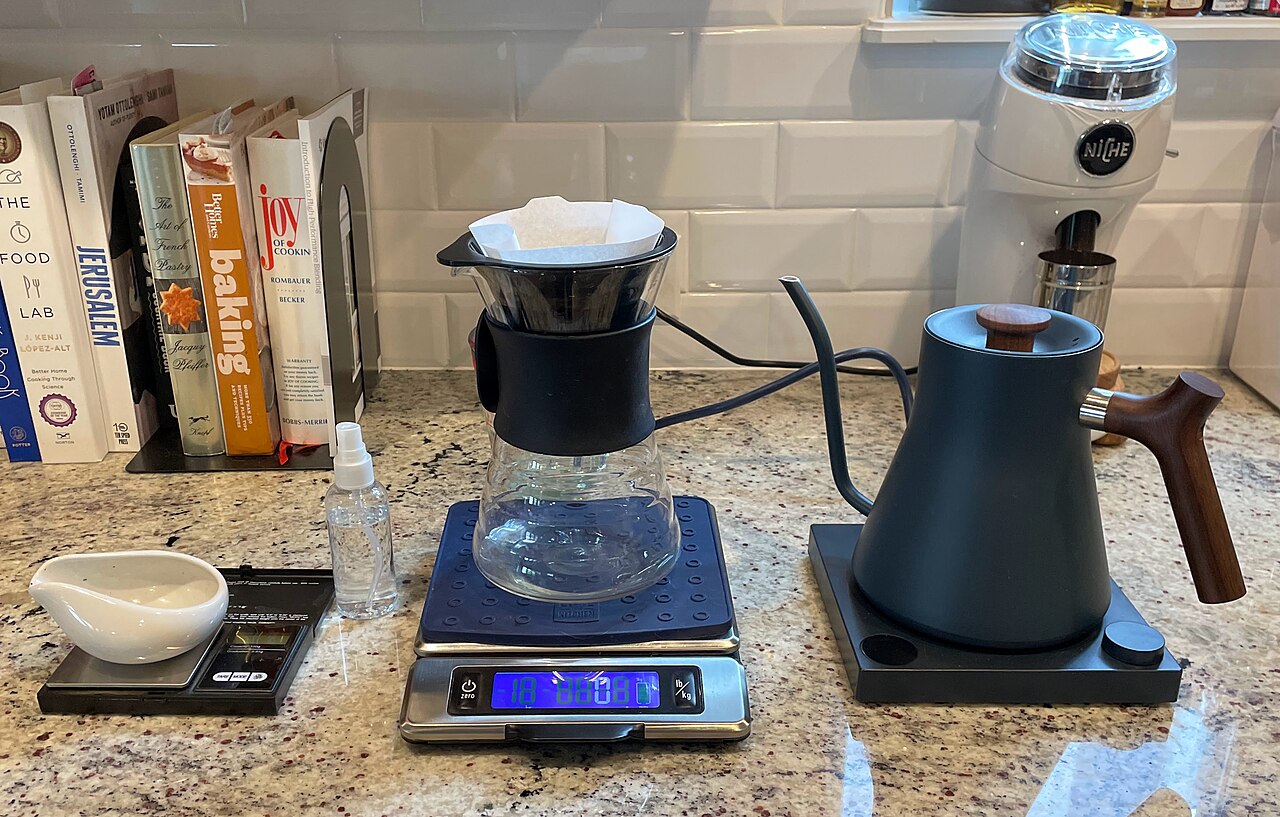
A gooseneck kettle’s thin, curved spout exists for one reason: control. Pour-over brewing lives or dies on a slow, steady, precise pour, and a regular kettle’s firehose spout makes that nearly impossible. This guide covers what separates a great gooseneck from a pretty one — flow control, balance, heating speed, and whether temperature control is worth the premium.
Why the spout shape matters
Pour-over extraction depends on keeping the coffee bed evenly saturated without agitating it into channels. A gooseneck’s narrow spout restricts flow to a thin stream you can aim precisely, pouring at a rate of a few grams per second. Try that with a standard kettle and you get a surging, splashing pour that digs holes in the coffee bed — the water channels through, under-extracting most of the grounds while over-extracting the channel walls. The result is the classic beginner pour-over: sour and bitter at once.
The spout’s curve also matters. A well-designed gooseneck gives a consistent flow rate whether the kettle is full or nearly empty, because the bend regulates the water column. Cheap goosenecks pour fine when full and dribble when half-empty. If you can test before buying, fill it and pour at half capacity — that is the real test.
Electric vs stovetop: the real tradeoff
Electric goosenecks heat fast (typically 3–5 minutes for a liter), hold a set temperature, and shut off automatically — you fill it, set 205°F, and walk away. For pour-over, where water temperature meaningfully affects extraction, that convenience is genuinely useful, not a gimmick. The premium is real, though: a good electric gooseneck costs several times a stovetop one.
Stovetop goosenecks cost little and last decades — there is nothing to break. The tradeoff is temperature guesswork: you boil, wait a bit, and pour, or use a thermometer. That is perfectly workable — people brewed excellent pour-over for years before electric kettles existed — but it adds friction to every brew. If you brew daily, the electric pays for itself in convenience within months.
Temperature control: worth it or marketing?
Water temperature changes extraction: hotter water extracts more, cooler water extracts less. For light roasts, hotter (205–212°F) helps pull out sweetness; for dark roasts, slightly cooler (195–200°F) avoids harsh bitterness. A variable-temperature kettle lets you match temperature to roast instead of guessing.
Is it essential? No. Boiling water left for 30–60 seconds lands around 200–205°F, which brews good coffee for most beans. Temperature control is a precision tool for people already controlling grind and ratio — if you are not yet weighing your coffee (see our scale guide), fix that first; it moves the cup more than five degrees of water temperature.
Balance, capacity, and the details that annoy later
A kettle lives on your counter, so the daily ergonomics matter. A counterweighted handle keeps the kettle balanced as water leaves — without it, a full kettle feels tippy and a near-empty one feels awkward. Capacity around 0.9–1 liter is the sweet spot: enough for two big pour-overs, small enough to stay nimble. Larger kettles get clumsy at the precise low pour rates pour-over needs.
Check the lid fit (a loose lid dribbles), the base stability, and — for electrics — whether the temperature display is readable and the hold function actually holds. Matte black finishes look great but show every water spot; stainless shows fewer. Neither affects the coffee.
What this guide does not cover
This is about kettles for pour-over coffee — not espresso machine boilers, not tea kettles (though a gooseneck works fine for tea), and not the water chemistry of brewing. It does not cover repairing electric kettles or descaling routines beyond the obvious: descale when your water is hard, following the manufacturer’s instructions, because scale kills heating elements faster than anything else.
Frequently asked questions
Can I use a regular kettle for pour-over?
You can, but pour control suffers badly — most people’s pour-over improves immediately when they switch to a gooseneck. It is the second most impactful pour-over upgrade after the grinder.
What temperature should I brew at?
Start at 200–205°F (93–96°C) for medium roasts. Go hotter for light roasts, cooler for dark roasts. Consistency matters more than the exact number — pick a temperature and keep it steady while you dial in grind and ratio.
Are expensive kettles actually better?
Up to a point: you are paying for precise temperature control, better balance, and build quality. Beyond the mid-range, you are paying for design and brand. A mid-range electric gooseneck is the value sweet spot.
How do I clean a gooseneck kettle?
Descale with citric acid or white vinegar solution when you see buildup, rinse thoroughly, and wipe the exterior. Never submerge an electric kettle base. Hard water areas need descaling every month or two.