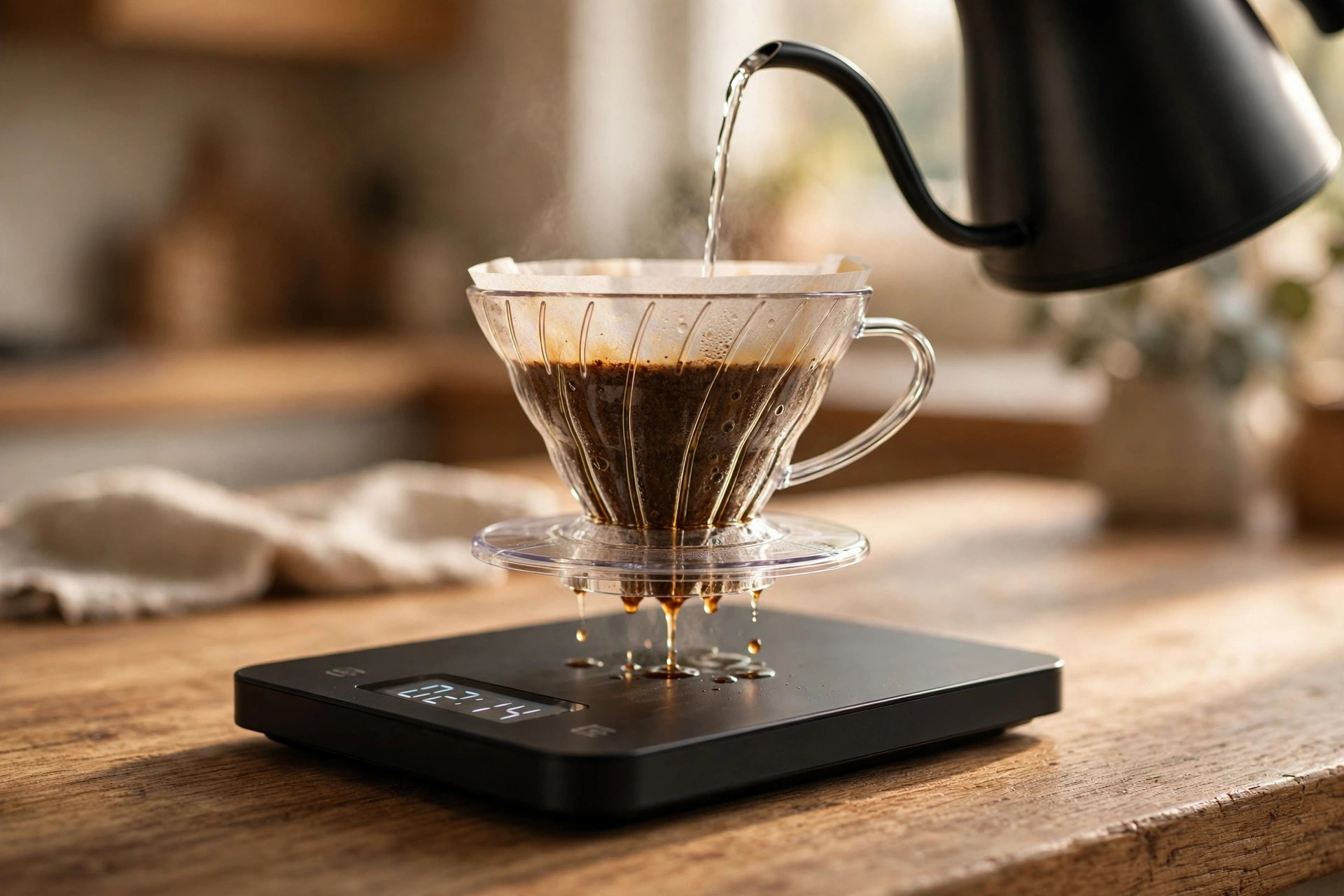
Ask a barista for the single cheapest upgrade to home coffee and you will not hear "grinder" — you will hear "scale." Scoops lie: two scoops of a light roast can weigh 30% less than two scoops of a dark roast, which means your ratio changes every bag and your "recipe" is fiction. A scale turns brewing from vibes into repeatability — same dose, same water, same result, every morning. This guide explains what actually matters in a coffee scale, how espresso and pour-over needs differ, and the five scales worth buying in 2026.
Why a scale beats scoops (the math)
Coffee brewing is a ratio: roughly 1 part coffee to 16 parts water for pour-over, 1:2 for espresso. Hit the ratio and the coffee tastes balanced; miss it and you get sour (under-extracted, too little coffee contact) or bitter (over-extracted). Scoops measure volume, but beans vary in density by roast level, origin, and age — volume is a proxy that drifts. Weight is the thing itself.
The second half is the timer. Pour-over and espresso are time-sensitive: a V60 that drains in 2:00 vs. 3:30 tastes like different coffee. A scale with a built-in timer puts both numbers — dose and time — in one glance, which is why the timer is not a gimmick but the feature that makes the scale a brewing instrument instead of a kitchen gadget.
What actually matters in a coffee scale
0.1g resolution: the whole point. A 1g-resolution kitchen scale cannot dose espresso (where 0.5g changes the shot) and is marginal for pour-over. 0.1g is the standard — accept nothing coarser. Response speed: cheap scales lag a half-second behind the pour, so you overshoot. Good scales update near-instantly, which is what makes them usable for live pouring rather than weigh-then-brew.
Timer: built-in, one-button, visible while pouring. Size: it must fit under your brewer with room for the cup — measure your dripper stand and espresso machine's drip tray clearance before buying. Water resistance: you will spill on it; a sealed top or silicone pad is the difference between a scare and a funeral. Auto-off behavior: a scale that sleeps mid-brew is infuriating — look for adjustable or disabled auto-off, a detail owners mention constantly in reviews.
Espresso vs. pour-over: different jobs
Espresso needs a small, fast scale that fits on a cramped drip tray and reads the shot weight in real time — 36g out in 28 seconds is the kind of target you cannot hit without one. Pour-over needs a larger platform that holds the dripper and server, with a timer you can read at a glance while pouring. One scale can do both if it is compact with a decent platform, but the extremes — tiny espresso scales and big brew scales — each do their job better. Buy for the brewer you use most.
How we compared them
We compared scale categories on the specs that decide daily usability: resolution and accuracy, display refresh speed, timer functionality, platform size and max capacity, water resistance, battery type and life, and auto-off behavior. We weighted response speed and auto-off above all — the two things that separate a scale you love from one you fight every morning.
An honest note: these are researched roundups built from manufacturer specifications and aggregated owner reviews — not hands-on side-by-side testing of every scale. The picks below are the categories whose owners report the fewest daily frustrations, so you can verify current reviews before you buy.
The five coffee scales worth buying in 2026
Standard 0.1g scale with timer — the default pick
The workhorse: 0.1g resolution, built-in timer, a platform big enough for a V60 and server, and a price that makes it the easiest recommendation in coffee gear. This is the scale that belongs in every home brewer's kit — it does pour-over, French press, AeroPress, and even espresso in a pinch, and it costs less than two bags of good beans.
When comparing options, filter reviews for the two killers: laggy display response and aggressive auto-off. The good ones in this category update instantly and let you disable the sleep timer; the bad ones turn a morning ritual into an argument.
- Pros: does every brew method well; 0.1g + timer covers the full workflow
- Pros: the best value in all of coffee gear — precision for the price of beans
- Cons: quality varies — laggy displays and bad auto-off ruin cheap ones
- Cons: too large for some espresso drip trays — measure first
Mini espresso scale — for the shot dialers
Built for the drip tray: compact enough to fit under the portafilter spouts of any home machine, fast enough to track the shot in real time, and usually with an auto-timer mode that starts when it senses the first drops. If you pull espresso daily, this is not optional equipment — dialing in without a scale is guessing, and guessing wastes expensive beans.
The trade-off is platform size: it will not hold a pour-over setup, so espresso-only households love it and multi-method brewers need the standard scale too. Many serious setups end up with both — the mini lives on the espresso machine permanently.
- Pros: fits any drip tray; auto-timer modes built for espresso workflow
- Pros: fast response tracks the shot live — essential for dialing in
- Cons: too small for pour-over servers — espresso-only tool
- Cons: tiny buttons can frustrate; check the timer controls in reviews
Waterproof scale — for the spill-prone
You will spill on your scale. Water, coffee, milk — the scale sits directly under the action, and standard electronics do not love it. Waterproof-rated scales with sealed bodies and silicone pads shrug off the daily splashes that slowly kill ordinary scales, which makes them the smart buy for busy kitchens, households with kids, or anyone who has already drowned one scale.
You pay a small premium for the sealing, and the sealed designs can be slightly slower to respond — check reviews for the lag question specifically. But a scale that survives five years beats a slightly faster one that dies in eighteen months.
- Pros: survives the spills that kill ordinary scales; silicone pad adds grip
- Pros: ideal for busy kitchens and anyone who has killed a scale before
- Cons: small price premium; sealed designs can be marginally slower
- Cons: "waterproof" usually means splash-proof — do not submerge it
Scale with flow-rate display — for pour-over nerds
The enthusiast tier: alongside weight and time, these scales show your real-time pour rate in grams per second — the variable that separates a good pour-over from a great one. Consistent agitation and drawdown depend on pour speed more than most brewers realize, and seeing the number trains your hand faster than any tutorial.
This is a luxury, honestly — the standard scale gets you 90% of the way there, and flow-rate is the final 10%. Buy it when your technique has plateaued and you want the data to push past it, not as your first scale.
- Pros: live flow-rate data trains pouring technique measurably faster
- Pros: usually the best-built scales in the category — premium everything
- Cons: premium price for a refinement, not a revolution
- Cons: overkill for beginners — master ratio and timing first
0.1g kitchen scale — the budget crossover
Not marketed as a coffee scale, but a 0.1g-resolution kitchen scale with a tare button does the core job — accurate dosing — for less money, and it doubles for baking and cooking. The compromises are real: no built-in timer (use your phone), slower display response, and usually no water resistance. But if the budget is tight, accurate weight plus a phone timer beats scoops by a mile.
Think of it as the gateway: it proves the concept, and when you are ready for the timer, the speed, and the spill protection, the standard coffee scale is waiting. Many brewers keep the kitchen scale for beans and the coffee scale for brewing permanently.
- Pros: cheapest path to accurate dosing; doubles for kitchen use
- Pros: 0.1g resolution is the spec that matters most — and it has it
- Cons: no built-in timer; slower response than purpose-built scales
- Cons: rarely water-resistant — keep it away from the pour zone
Our verdict
Buy the standard 0.1g scale with a timer — it is the single best value in coffee gear, full stop. Espresso obsessives should add the mini scale for the drip tray; the spill-prone should get the waterproof version; pour-over nerds chasing the last 10% want the flow-rate display. And if the budget says no to all of it, a 0.1g kitchen scale plus your phone timer still beats scoops by an embarrassing margin.
Using it right: ratio, timing, and the routine
The scale only helps if you use the numbers. Start with 1:16 for pour-over — 20g of coffee to 320g of water — and 1:2 for espresso — 18g in, 36g out. Start the timer when the water hits the grounds (or when the pump starts), and write down what you taste. The magic of the scale is not precision for its own sake; it is that when a cup is great, you can make it again, and when it is off, you know exactly which variable to change.
Two habits make it stick. First, weigh the dose, not the scoops — grind directly into the cup on the scale, tare, and stop at your number. Second, weigh the water too for pour-over — pouring to a target weight is more accurate than eyeballing lines on a server, and it is how you learn what your pour actually looks like. Within two weeks the numbers become reflex, and going back to scoops feels like cooking blindfolded. See our coffee scale deep-dive for more on technique.
Frequently asked questions
Is 0.1g precision really necessary?
For espresso, yes — half a gram visibly changes a shot. For pour-over, it matters less, but 0.1g scales cost barely more than 1g ones now, so there is no reason to accept coarser resolution.
Can I just use my phone timer with a kitchen scale?
Absolutely — the timer's job is just to count. The built-in timer is a convenience, not a necessity. What you cannot replace with a phone is the 0.1g resolution and the fast display response.
Why does my scale turn off mid-brew?
Aggressive auto-off to save battery — the most common scale complaint in existence. Look for adjustable or defeatable auto-off when buying; on your current scale, tapping the platform periodically keeps it awake.
Do I need a scale for French press too?
Yes — arguably more than for pour-over, since immersion brewing has no visual feedback at all. Dose the coffee, weigh the water, set a four-minute timer: the scale makes French press repeatable instead of random.